How to Cite
Abstract
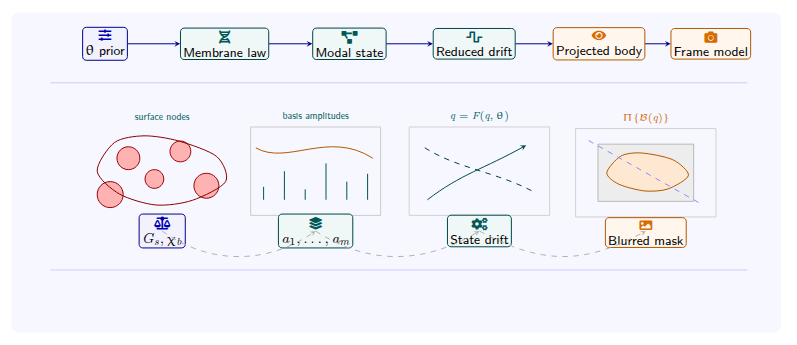
Microfluidic images of deformable cells contain mechanical information, yet that information is usually indirect because the measured object is a two-dimensional projection of a moving three-dimensional membrane. Parameter estimates obtained from final shapes alone can there- fore hide non-uniqueness, especially when viscosity ratio, elastic modulus, reference geometry, and optical blur influence the same outline. This paper develops a numerical observer for re- covering membrane parameters from short sequences of projected cell silhouettes in pressure driven microchannels. The model couples a reduced capsule forward solver, a differentiable im- age formation map, and a Bayesian filtering procedure that updates posterior distributions over shear modulus, bending ratio, viscosity ratio, reference-shape inflation, and inlet orientation. The results are generated as controlled in silico records with prescribed imaging noise rather than as experimental measurements. Across 1,260 generated sequences, the observer recovers shear modulus within 6.8% median relative error when at least 18 frames are available and the viewing direction is not aligned with the weakest projected deformation axis. Viscosity ratio remains less identifiable from outlines alone, with median error 15.4%, but improves to 9.7% when centroid lag is included. A sequential acquisition rule reduces the number of required frames by 31% relative to uniform sampling. The study indicates that transient silhouettes can support quantitative membrane inference when the observer is allowed to use the order of shape changes, not only their final appearance.