How to Cite
Abstract
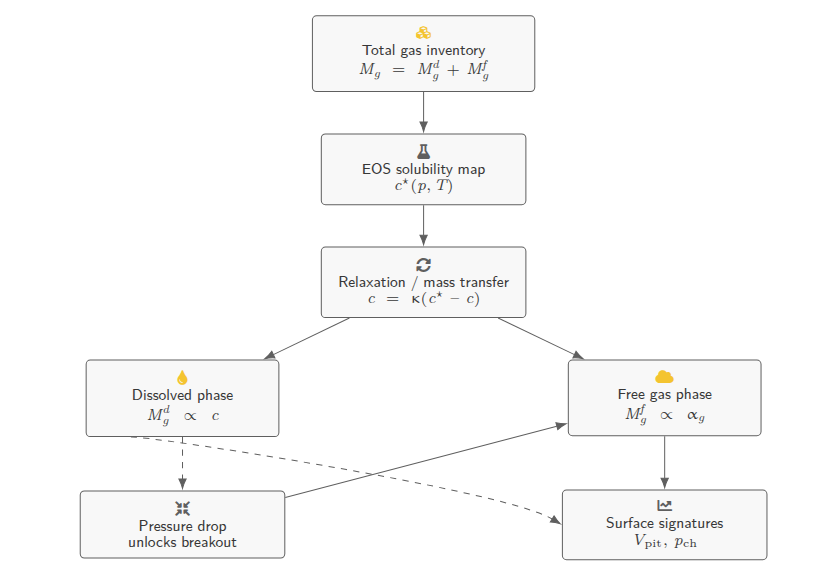
Gas influx events during drilling remain a principal source of nonproductive time and a persistent precursor to loss-of-well-control incidents. Modern rigs provide dense surface instrumentation, yet the mapping from surface pressure and flow signals to evolving downhole multiphase states is often nonunique because of coupled effects from compressibility, slip, friction, temperature variation, and transient boundary conditions. This paper develops a solubility-aware, reduced-order digital twin and a Bayesian state-estimation scheme that jointly infer kick onset, influx mass, and migration dynamics using only surface measurements and routine rig telemetry. The core modeling contribution is a thermodynamically consistent partition of the influx gas between dissolved and free phases, coupled to a drift-flux-based annular momentum closure and a temperature-dependent equation of state, enabling fast evaluation without solving full-field computational fluid dynamics. The inference contribution is a sequential probabilistic filter that propagates uncertainty through the reduced-order dynamics while assimilating standpipe/choke pressures, pit volume, and pump-rate data, yielding posterior distributions over kick size and location rather than point estimates. A regime-aware closure is introduced through a constrained, differentiable surrogate for friction and slip that preserves physical monotonicity and mass conservation, allowing robust operation across shut-in and circulating conditions. Numerical experiments over a broad range of depths, mud properties, and influx scenarios demonstrate that incorporating dissolution reduces systematic bias in inferred influx volume and improves early-warning reliability under realistic sensor noise. The resulting framework is designed for real-time use, emphasizing identifiability, bounded computational complexity, and control-relevant outputs.

This work is licensed under a Creative Commons Attribution-NonCommercial-ShareAlike 4.0 International License.
Copyright (c) 2023 authors